

Living in a studio apartment can feel surprisingly comfortable—until your bed becomes the first thing you see when you walk through the door, your pillows collect cooking smells, or your living room starts feeling like an extension of your bedroom. When one open room has to function as a bedroom, lounge, dining area, and sometimes a home office, the layout matters just as much as the furniture you choose.
The good news is that you don’t need to build a wall or rent a bigger apartment to make your space feel more organized. A curtain, an open bookshelf, a carefully positioned sofa, or even a change in lighting can create the feeling of separate rooms without sacrificing precious floor space. The trick is finding a layout that gives your bed its own visual boundary while keeping the apartment bright, practical, and easy to move around.
These studio apartment layout ideas focus on realistic solutions for renters, small-space dwellers, and anyone who wants a more private sleeping area. You’ll find budget-friendly dividers, furniture arrangements, storage ideas, layout comparisons, and shopping suggestions to help you turn one open room into a home that feels like it has distinct spaces.
Quick takeaway: If you want the biggest change without construction, start by placing your sofa with its back toward the bed, adding a rug to define the living area, and installing a ceiling-mounted curtain track around the sleeping zone if your layout allows.
Why Separate Sleeping and Living Areas in a Studio?
A studio apartment doesn’t have to feel like one large room where every activity happens in the same spot. Even without permanent walls, creating distinct zones can make everyday life feel more organized. A defined sleeping area gives you somewhere to unwind, while a separate living zone makes it easier to entertain friends, watch television, read, or simply relax without feeling as though you’re sitting on your bed all evening.
There is also a visual benefit. When the bed, sofa, coffee table, and wardrobe all compete for attention, a small room can feel cluttered even when it is relatively tidy. Separating these elements gives the eye a clearer path through the space. The apartment starts to feel intentional rather than like a collection of furniture squeezed into one room.
Privacy matters, too. If you share your studio with a partner, occasionally host overnight guests, or work from home, even a partial divider can create a welcome sense of separation. You may not achieve complete soundproofing, but you can make the bed less visible from the entrance or sofa.
Before choosing a divider, decide what you actually want it to do. A decorative screen may be enough if your goal is to hide the bed from view. If you need to change clothes privately or block light from a television, a more substantial curtain or partition may be more useful.
Choose your layout based on your main priority:
- Visual separation: An open bookshelf, sofa placement, or rug.
- Privacy: Full-length curtains, a folding screen, or a more substantial divider.
- Storage: A bookcase, wardrobe, or storage headboard.
- Natural light: Open shelving, glass panels, or slatted dividers.
- Flexibility: A folding screen, ceiling track, or movable furniture.
The best studio layouts often combine two simple ideas rather than relying on one oversized divider.
Plan Your Studio Layout Before Buying Anything
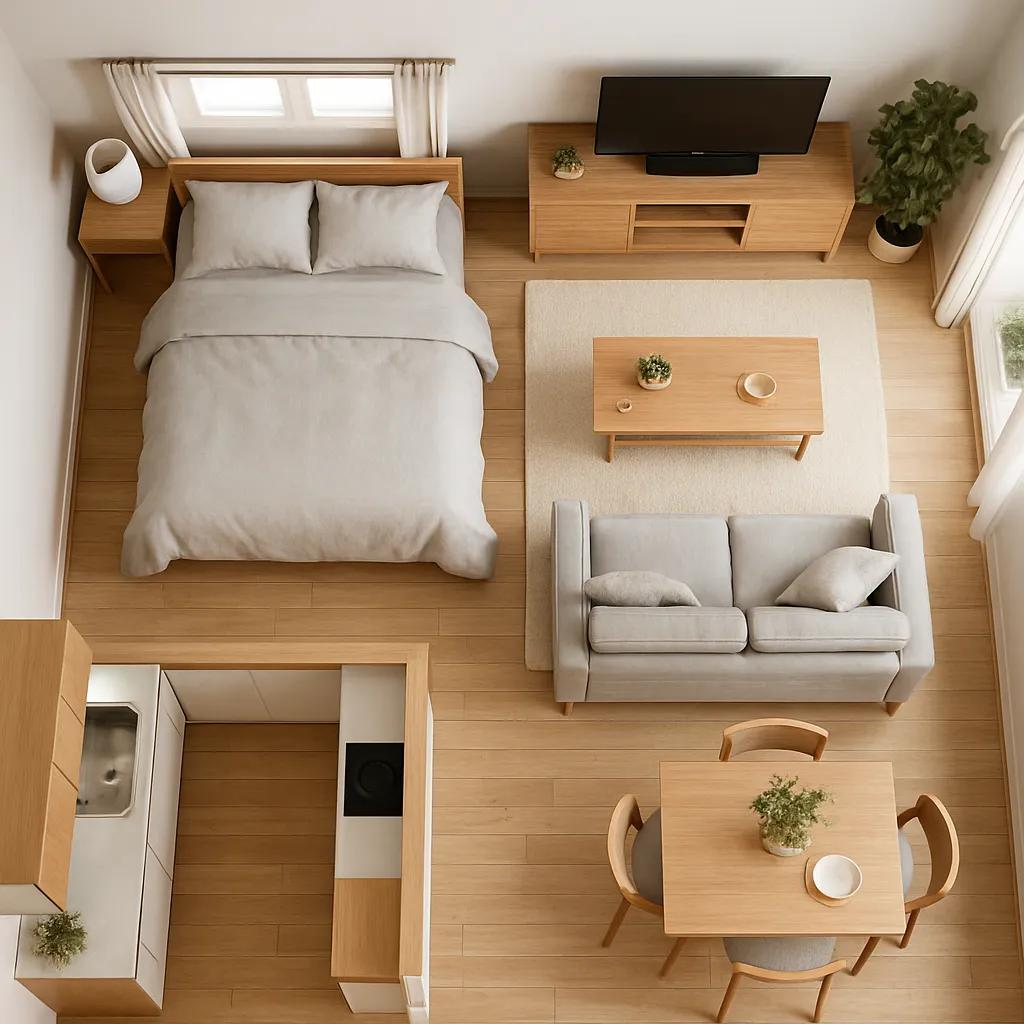
It’s tempting to start shopping for a beautiful room divider as soon as you decide to separate the bed. But buying furniture before understanding the room can create a new problem: the divider may be too wide, block a window, or leave an awkward passage between the bed and the kitchen.
Start with the furniture you already own. Measure your bed, sofa, wardrobe, and dining table, then sketch the room from above. Mark the entrance, windows, heating equipment, kitchen cabinets, electrical outlets, and any doors that need to swing open. This simple exercise helps you identify where a divider can fit without interrupting the natural flow of the apartment.
Measure the Room and Map Out Daily Movement
Think about your daily routine rather than just the room’s appearance. Can you walk from the entrance to the kitchen without weaving around a coffee table? Can you make the bed without moving a chair? Can you open the wardrobe doors fully? These questions matter more than fitting every furniture piece into a perfectly symmetrical arrangement.
Pay special attention to the path between the entrance and the sleeping area. If the bed is directly visible from the doorway, a partial screen or strategically positioned bookcase may be enough to change the view. You don’t necessarily need to hide the entire bed.
Where possible, keep the main walking route clear and avoid narrow gaps that force you to turn sideways. The right clearance depends on the room and the furniture, so test the arrangement with masking tape on the floor before committing to a purchase.
Choose Between Visual Separation and Real Privacy
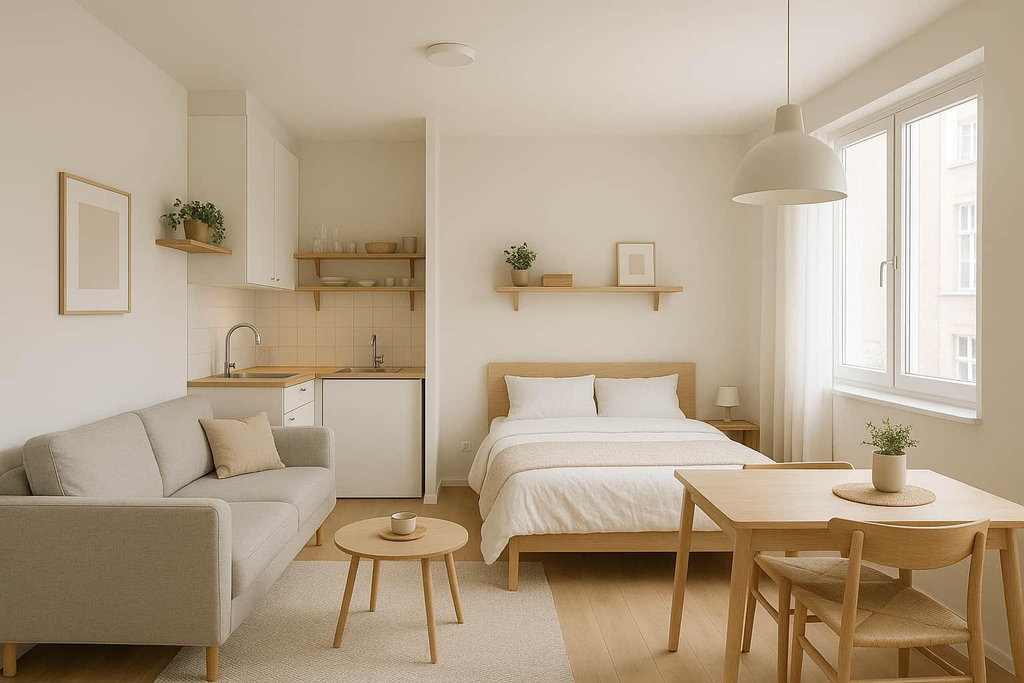
Not all dividers work in the same way. Some simply create a visual boundary, while others provide more coverage and flexibility. A low shelf can define the sleeping area but won’t conceal the bed completely. A sheer curtain softens the view but may still reveal silhouettes when the room is lit at night.
Use this comparison to narrow down your options.
| Divider type | Visual separation | Privacy | Natural light | Best for |
|---|---|---|---|---|
| Sheer curtain | Moderate | Low | High | Bright, airy studios |
| Opaque curtain | High | Moderate to high, depending on gaps | Low when closed | Renters wanting flexibility |
| Open bookshelf | High | Moderate | Medium to high | Storage and zoning |
| Folding screen | High | Moderate | Medium | Temporary layouts |
| Glass partition | High | Limited unless frosted or curtained | High | Contemporary interiors |
| Wardrobe | Very high | High from direct view | Low to medium | Storage-heavy layouts |
| Sofa placement | Moderate | Low | High | Open-plan studios |
| Indoor plants | Low to moderate | Low | High | Soft, decorative separation |
Remember that visual privacy isn’t the same as sound privacy. Curtains, shelves, and decorative screens won’t reliably block conversations, television noise, or other sounds.
15 Studio Apartment Layout Ideas That Create Separate Zones
1. Use Ceiling-Height Curtains for Flexible Privacy

Best for: Renters, narrow studios, and anyone who wants to hide the bed at night without permanently dividing the room.
Curtains are one of the easiest ways to create a separate sleeping area because they occupy very little floor space. A ceiling-mounted track can run across the room or around one side of the bed, allowing you to draw the fabric closed whenever you want more privacy. During the day, pull the curtains aside and the studio returns to its open layout.
For a soft, airy look, choose ivory, warm white, or pale beige curtains. If you want stronger visual separation, select a heavier opaque fabric. Linen-look panels work beautifully in neutral interiors, while darker curtains can add contrast in a contemporary apartment.
The track matters as much as the fabric. A ceiling track creates a cleaner appearance than a decorative rod in many modern studios, particularly when the curtains extend from ceiling to floor. Before drilling, check your lease and confirm that the mounting method is appropriate for the ceiling. If permanent installation isn’t allowed, look for a suitable freestanding or tension-based solution designed for the room’s dimensions.
A useful trick is to hang the curtain slightly beyond the width of the bed, giving yourself enough space to enter the sleeping zone without squeezing around the fabric. Make sure the panels don’t drag across a heater, obstruct a door, or interfere with ventilation.
Styling formula: Full-length cream curtains + neutral bedding + a warm bedside lamp + a slim side table.
2. Position an Open Bookshelf Between the Bed and Sofa
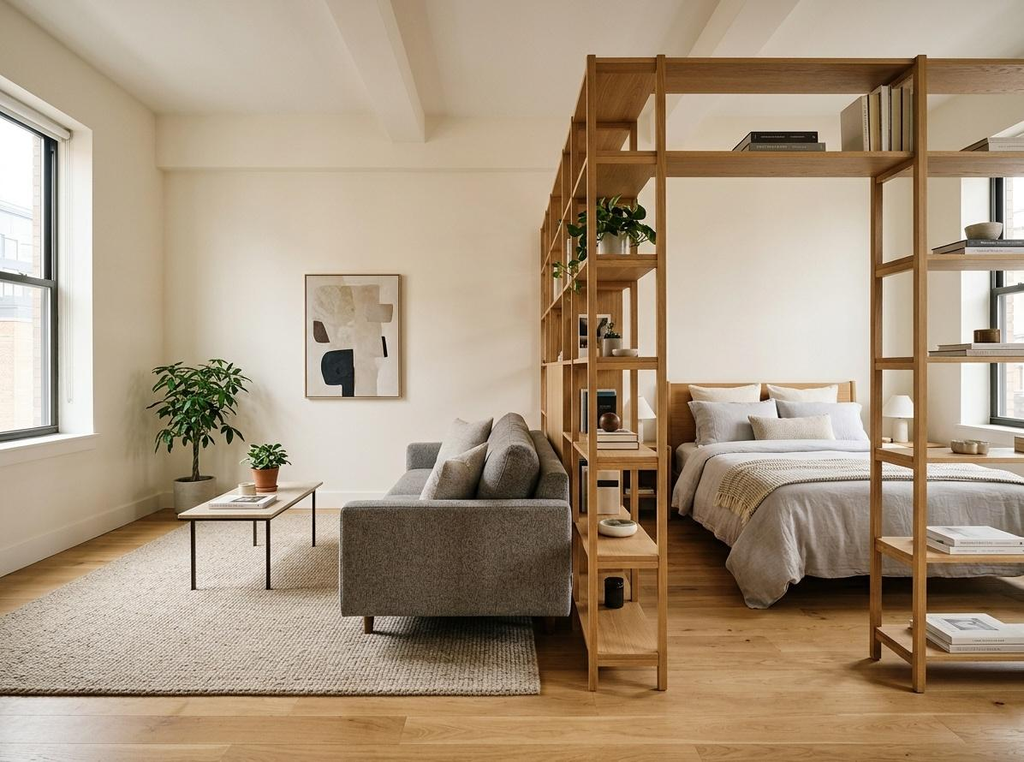
An open bookshelf can act as a room divider, storage unit, and display area all at once. Instead of pushing a large bookcase against a wall, position it between the bed and living area so each side feels like it belongs to a different zone.
The beauty of this approach is that you gain useful storage without completely blocking daylight. Open-backed shelving allows light and some sightlines to pass through, making it particularly useful in studios where a solid wall would feel too heavy. Use the shelves for books, baskets, small lamps, framed prints, and a few decorative objects.
Avoid filling every shelf. A crowded bookcase can look bulky and create visual clutter, defeating the purpose of making the studio feel calmer. Leave some openings visible, alternate books with baskets, and keep the heaviest-looking objects toward the bottom.
Safety is essential. A tall or narrow bookcase can tip, especially if someone bumps into it. Choose a unit intended to stand independently and secure it according to the manufacturer’s instructions. Don’t assume that a heavy bookcase is automatically stable.
For a cohesive look, coordinate the shelf finish with your flooring or larger furniture. Light oak works well in warm neutral rooms, while black metal frames suit industrial and modern interiors.
3. Create a Bedroom Nook With a Room Divider
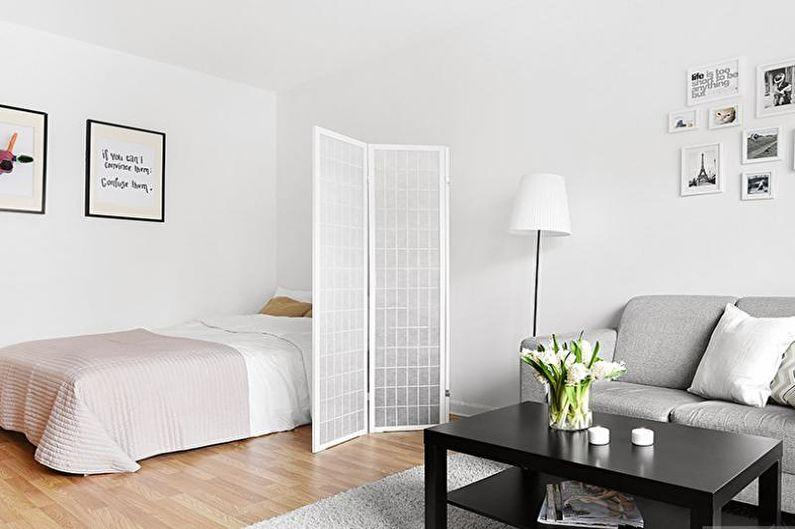
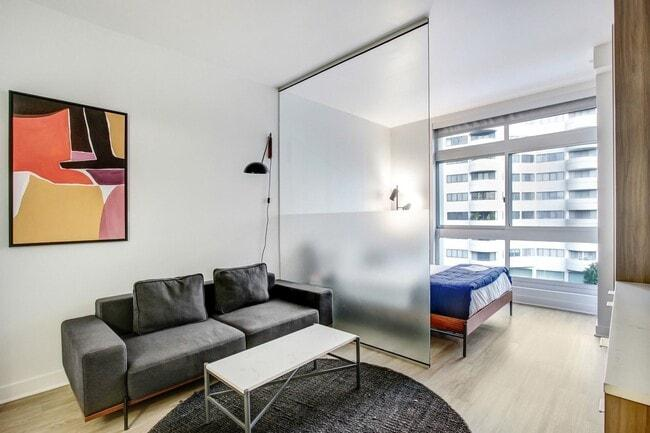
Sometimes you don’t need to divide the entire apartment. You simply need to create a nook that makes the bed feel tucked away. A freestanding partition placed along one side of the mattress can provide that visual boundary while leaving the rest of the studio open.
This arrangement works particularly well when the bed sits against a side wall or in a corner. A divider can conceal the mattress from the main seating area, while a narrow bedside table and wall-mounted reading light help the nook feel intentional.
Choose a partition with a finish that relates to the rest of the room. Wood slats add warmth, painted panels create a cleaner contemporary appearance, and woven screens introduce texture without looking too formal. If the apartment is dark, avoid a solid partition that blocks the only source of natural light.
Think carefully about how you enter the nook. Leave enough room to walk around the bed, change the bedding, and access storage. A divider that looks lovely but makes everyday tasks frustrating isn’t a good long-term solution.
For a more built-in appearance, repeat the divider’s material somewhere else, such as a wooden side table, a woven pendant, or a slim console in the living area.
4. Place the Sofa With Its Back to the Bed
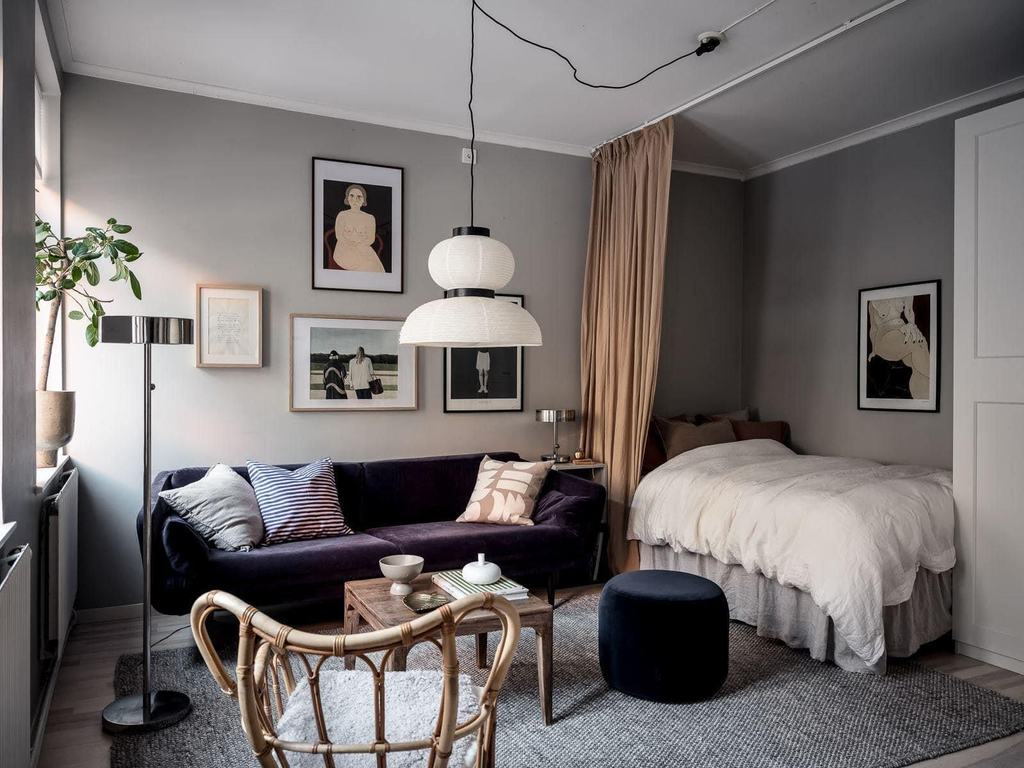
If your studio is wide enough, try positioning the sofa so its back faces the bed. This creates a natural boundary between the sleeping area and living room without requiring another piece of furniture.
The sofa becomes the visual anchor of the lounge, giving you a clear place for a coffee table, rug, and television or media unit. Behind it, the bed reads as a separate zone rather than part of the seating arrangement. This layout can feel surprisingly effective because it uses furniture you already need instead of adding a divider that takes up more space.
Choose a sofa with a back that looks finished from every angle. Some models are designed to sit against a wall, leaving exposed frames, upholstery seams, or unfinished panels visible when positioned in the middle of a room. A compact two-seater or apartment sofa may work better than an oversized sectional.
A narrow console table behind the sofa can add another layer of separation and provide a place for a lamp, books, or keys. Just make sure it doesn’t turn the walkway into a tight squeeze.
This layout works best when the sofa doesn’t block access to the windows or kitchen. If the room is extremely narrow, a smaller loveseat or armless sofa may be more practical than a full-size couch.
5. Use a Large Rug to Define the Living Area
A rug doesn’t hide the bed, but it can make the apartment feel divided into clear zones. Think of it as drawing an invisible boundary around the living room. When the sofa, coffee table, and front legs of the seating furniture sit on or around the rug, the lounge reads as a distinct area.
Choose a rug large enough to relate to the furniture rather than a tiny mat floating in the middle of the floor. The right size depends on the room and sofa, but the aim is to make the living arrangement feel connected. In a small studio, a simple pattern or low-contrast neutral often works well because it defines the space without overwhelming it.
You can also use a different rug or runner near the bed to reinforce the sleeping zone. For example, a flatwoven rug under the living furniture and a soft bedside rug create two subtly different areas without adding a physical barrier.
Texture is a useful tool here. A woven rug can bring warmth to a minimalist room, while a low-pile patterned rug adds definition without competing with the bedding.
Try this combination: A neutral sofa, a medium-sized textured rug, a compact coffee table, and a floor lamp positioned at the edge of the seating zone.
For more inspiration on coordinating finishes, see PaletteDiary’s guide to warm neutral color ideas.
6. Add a Storage Headboard or Low Partition
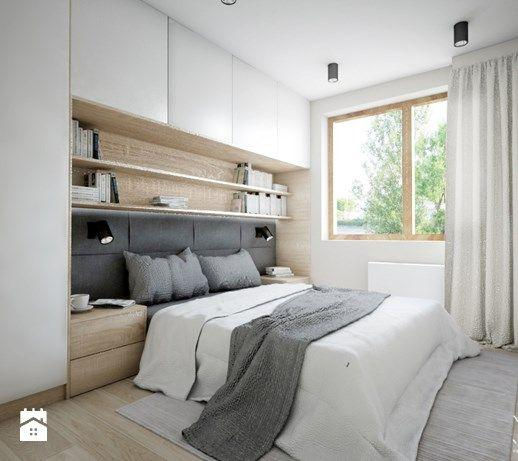
A storage headboard or low divider can separate the bed from the living area while keeping everyday essentials close at hand. Depending on the design, it might provide shelves for books, compartments for bedding, a ledge for a lamp, or a slim surface for decorative objects.
This option is useful when you don’t have enough room for a full-height bookcase. A low partition keeps the apartment visually open and can create a gentle boundary without making the sleeping zone feel boxed in.
Look for a unit with a depth that fits the available space. Deep storage may offer more capacity, but it can also eat into the walking area. If the bed is already close to the sofa, a slim headboard shelf or wall-mounted ledge might achieve the same effect with less bulk.
Keep the styling simple. A couple of books, a small plant, and a lamp are often enough. If the divider has open cubbies, use matching baskets to hide smaller items and reduce visual clutter.
A storage headboard can also help make a bed feel intentional rather than temporary. When the bed has its own lighting, storage, and defined boundary, the sleeping area begins to resemble a small bedroom—even when it’s part of a single open room.
7. Use a Folding Screen for an Instant Bedroom Boundary
A folding screen is a practical option when you want separation without installing anything. You can position it beside the bed when you need privacy, fold it away when you want more open space, or move it to another part of the apartment when your needs change.
Screens come in a wide range of materials. Woven rattan and cane suit natural, relaxed interiors; fabric-covered screens feel soft and understated; and simple wood or metal designs work well in contemporary apartments.
The main advantage is flexibility. Unlike a fixed partition, a folding screen can adapt when you rearrange the room or host guests. It’s also useful for renters who aren’t allowed to drill into walls or ceilings.
However, not every screen is equally stable. Check its footprint and base, particularly if you have pets, children, or a narrow walkway. A very lightweight screen may wobble, while a large opaque one may make a small room feel darker than expected.
For a softer look, choose a screen that complements the curtains or bedding rather than introducing another unrelated finish. If you already have a lot of patterns, a simple solid-color screen can bring balance to the room.
8. Separate Zones With Different Lighting
Lighting can make a studio feel divided even when no physical divider exists. A warm bedside lamp creates a clear sleeping zone, while a floor lamp or pendant helps establish the living area. Because the eye naturally responds to pools of light, each area can feel like it has its own purpose.
Start with the bed. A wall-mounted reading light or compact bedside lamp gives the sleeping area a gentle glow without requiring a large nightstand. In the living area, use a floor lamp near the sofa or a table lamp on a console to create a second lighting point.
Avoid relying on a single bright ceiling light for everything. It may illuminate the room, but it rarely creates the comfortable atmosphere you want in the evening. Multiple light sources give you more control and help different activities feel separate.
You can also use lighting to highlight a divider. A small lamp on an open bookshelf makes it feel more like a designed feature, while a soft LED light behind a headboard can visually distinguish the bed from the rest of the room. Choose fixtures and bulbs appropriate for the setting, and keep electrical cords safely out of walkways.
For further ideas, browse PaletteDiary’s living room lighting ideas and adapt the principles to your studio.
9. Create a Glass or Slatted Divider
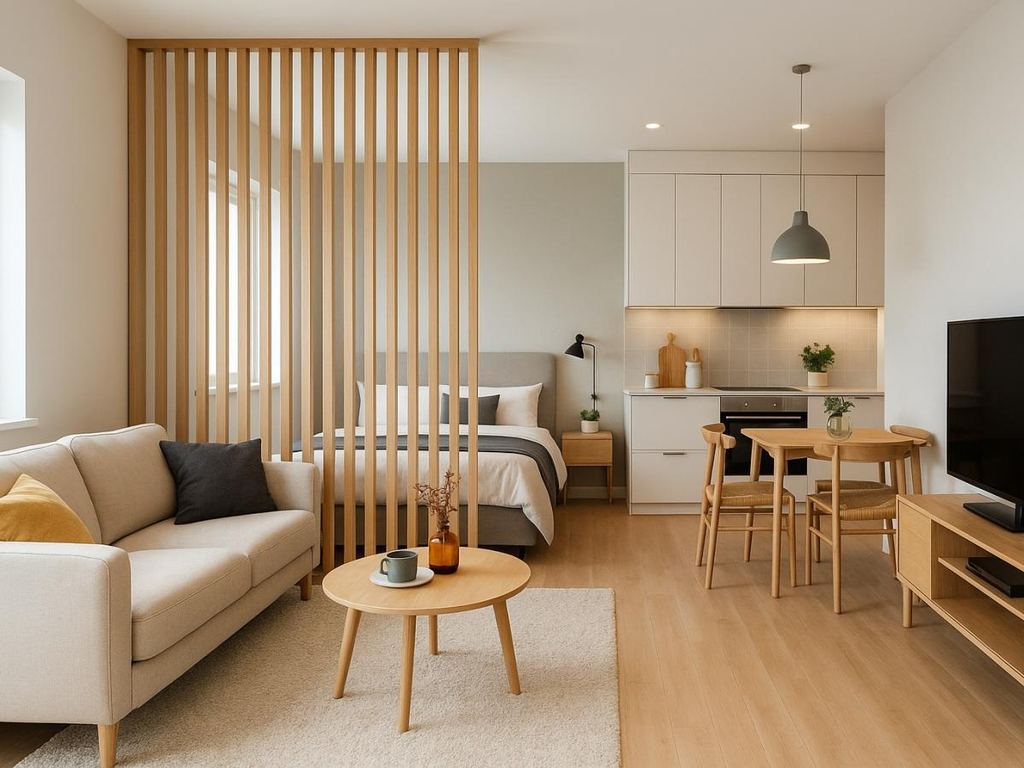
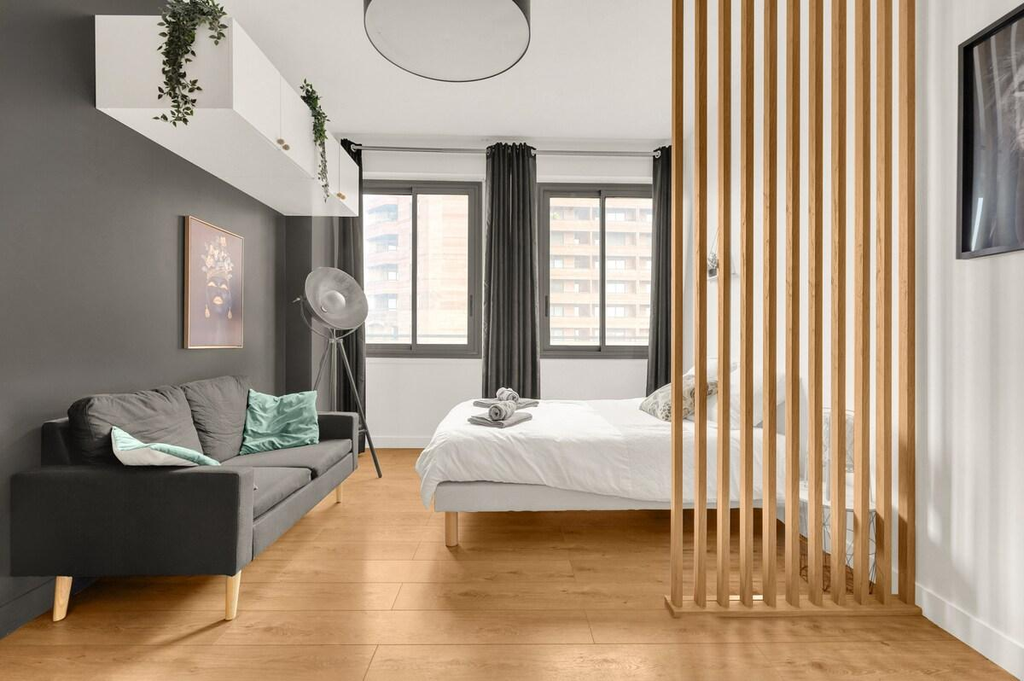
If you want a more architectural look, consider a glass or slatted partition. These options provide a clearer boundary than a rug or sofa arrangement while allowing some light to pass through.
A glass divider can feel sleek and contemporary, particularly when the studio has large windows or a neutral palette. Clear glass preserves sightlines, while frosted or textured glass offers more visual privacy. However, transparent glass won’t hide the bed completely, and full-height panels may require professional installation or landlord approval.
Wooden slats offer a warmer alternative. The gaps between slats allow light and air to move through the room, while the vertical lines create a strong design feature. Slats can also connect with wooden furniture, flooring, or shelving.
Before choosing either option, consider safety, stability, cleaning, and installation. Glass panels need appropriate safety specifications and secure mounting. Slatted dividers need to be fixed properly if they are tall or freestanding.
These solutions are often more expensive than curtains or folding screens, so they’re best for people who plan to stay in the apartment for a while or have permission to make more permanent changes.
10. Use a Wardrobe to Form a Private Sleeping Zone
A wardrobe can serve as more than a place to store clothes. Positioned strategically, it can create a solid visual barrier between the bed and living area while solving one of the biggest challenges in a studio: limited storage.
This arrangement works particularly well when the apartment has a long rectangular shape. Place the wardrobe along the side or foot of the bed to form a boundary, leaving a clear route between the entrance, kitchen, and sleeping area.
The main drawback is its visual weight. A tall, solid wardrobe can block light and make a narrow studio feel divided into cramped sections. To reduce that effect, choose a finish close to the wall color, keep the surrounding decor simple, or combine the wardrobe with a shorter open shelf.
Check the door swing and drawer clearance before finalizing the position. Sliding wardrobe doors can be helpful where there isn’t enough space for hinged doors to open comfortably.
Also consider stability and installation. Tall wardrobes may need wall anchoring, and you should never block required exits, heating equipment, or ventilation. If your lease restricts drilling, check whether a safe alternative is available before purchasing a large unit.
11. Put the Bed in a Corner or Alcove
If your studio has a natural recess, use it. An alcove can provide a ready-made sleeping zone, allowing the bed to feel separate without adding a divider across the main room.
Place the bed so the headboard sits against a solid wall where possible. Then use wall-mounted reading lights, a narrow bedside shelf, and coordinated bedding to make the nook feel finished. If the alcove is deep enough, curtains across the opening can provide extra privacy without dividing the whole studio.
Not every apartment has a true alcove, but a corner can create a similar effect. Position the bed against two walls if the room allows, then use a rug, screen, or tall plant at the open side to reinforce the boundary.
Be careful not to squeeze the bed into a corner that makes it difficult to change sheets or get in and out. If two people share the bed, access on both sides may be important. In a very small studio, you may need to prioritize circulation over a perfectly symmetrical arrangement.
The goal is to make the sleeping area feel tucked away while preserving a comfortable route through the rest of the apartment.
12. Define Zones With Color and Accent Walls
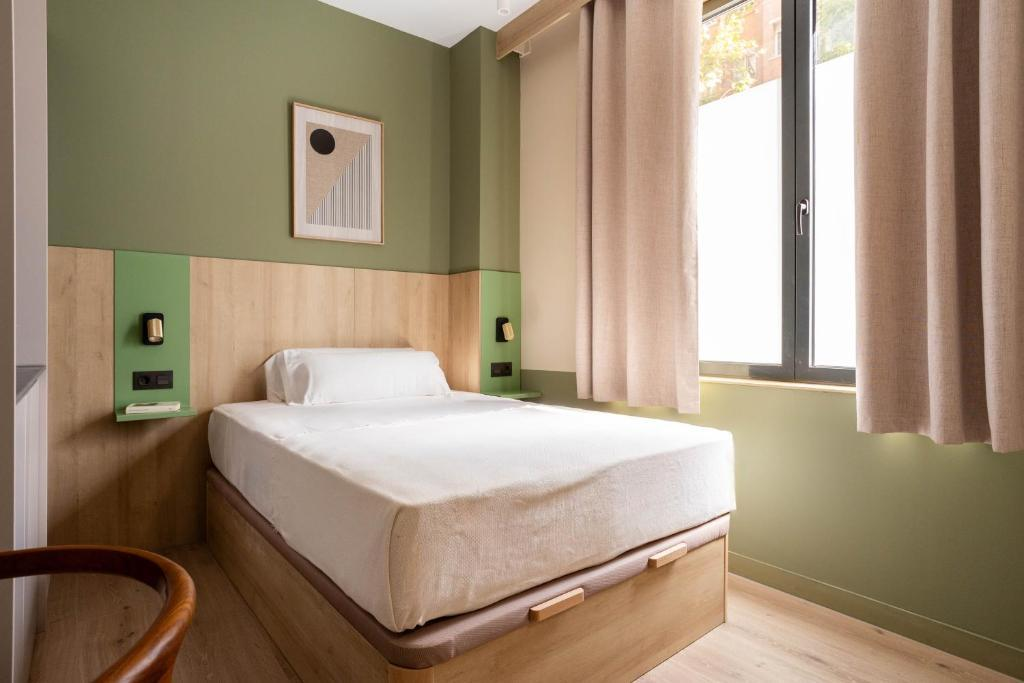
Color can create a surprising amount of separation without taking up any floor space. Paint the wall behind the bed a different shade from the living area, or use removable wallpaper to establish a visual backdrop for the sleeping zone.
A muted green, warm taupe, dusty blue, or soft clay shade can distinguish the bed area while keeping the apartment cohesive. If you prefer a more subtle approach, use a darker tone behind the headboard and repeat that color in cushions or artwork near the sofa.
You don’t have to paint the entire wall to make the idea work. A carefully placed panel of removable wallpaper, a large piece of art, or a fabric headboard can create a focal point that visually anchors the sleeping area.
Keep the palette limited. In a studio, too many unrelated colors can make the room feel chopped up rather than organized. Choose one main neutral and one or two accent shades, then repeat them in different textures across both zones.
If you’re renting, review the rules about painting and wallpaper before making changes. Removable products can still damage some finishes, so test them in an inconspicuous area first.
13. Use a Murphy Bed or Daybed to Free Up Space
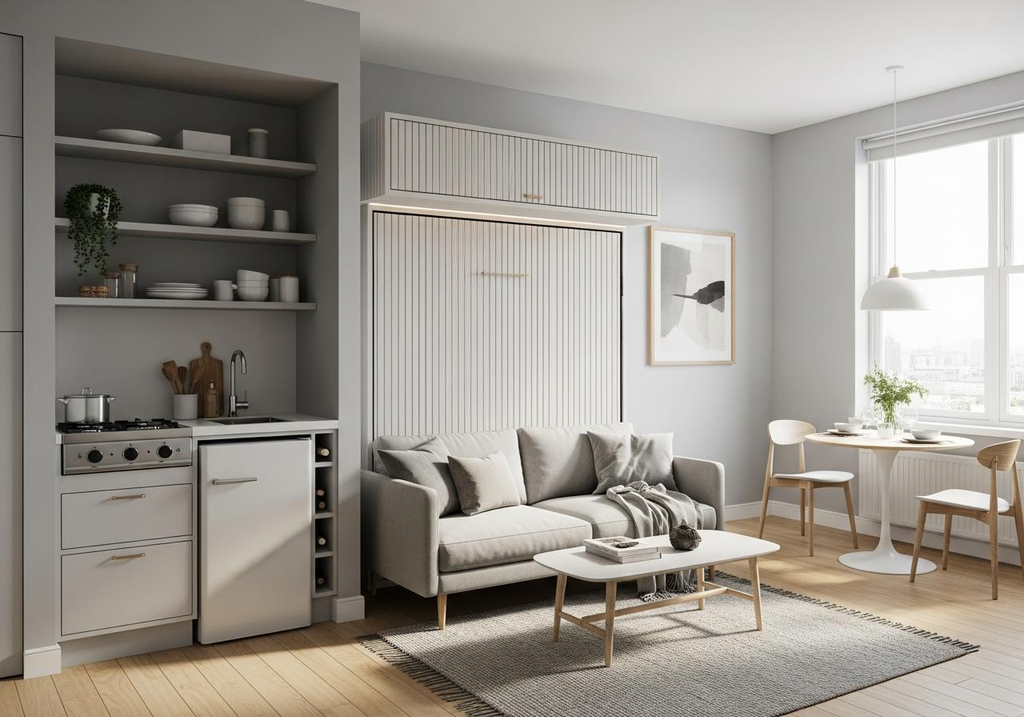
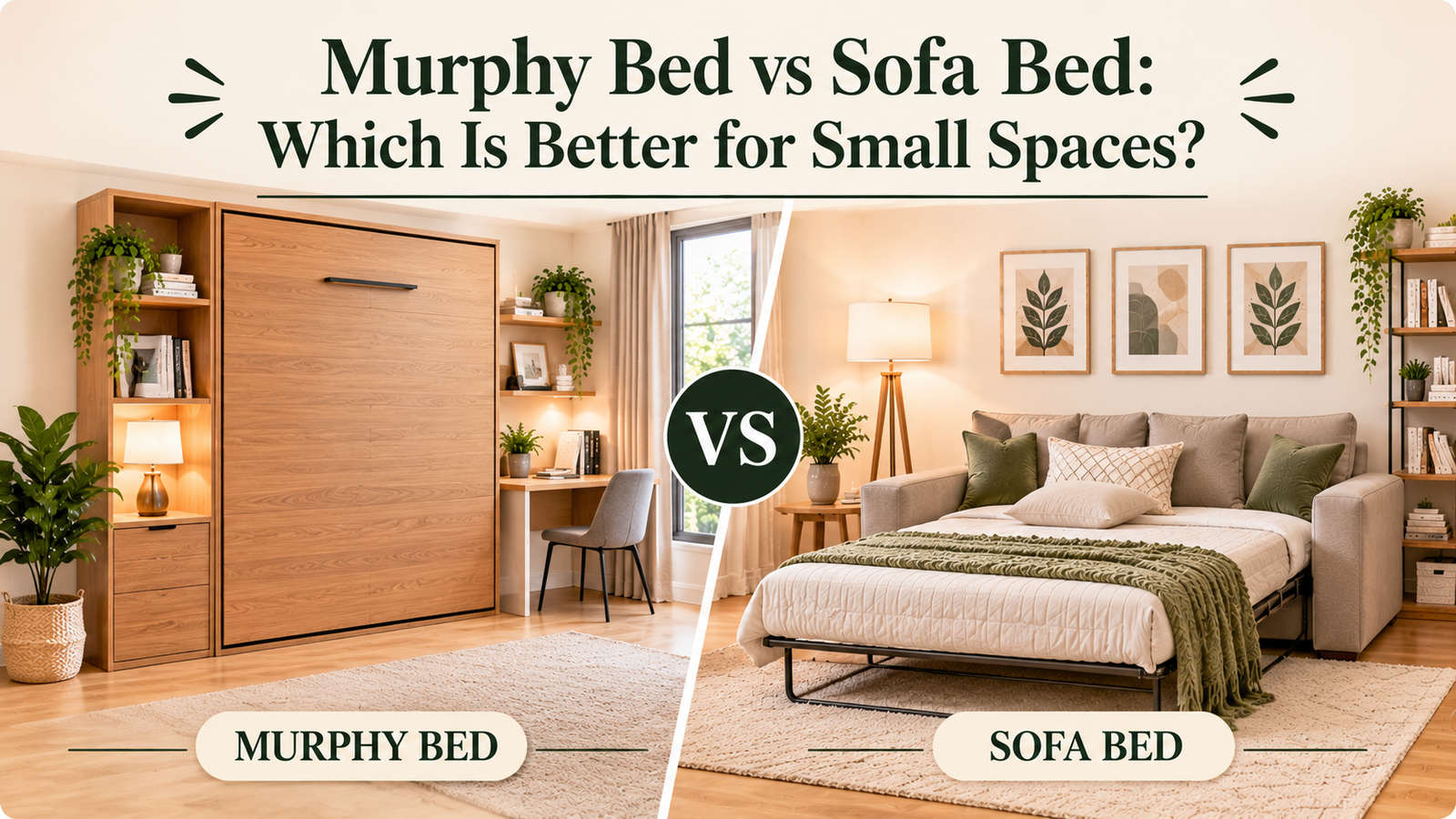
If your bed takes up most of the studio, changing the bed itself may be more effective than adding a divider. A Murphy bed folds into a wall-mounted cabinet when not in use, freeing floor space for living or working during the day. A daybed can also function as a sofa, although the sleeping and lounging surfaces remain more visually connected.
Murphy beds are useful when the room needs to perform several functions. With the bed folded away, you may have enough space for a larger seating area, a compact dining table, or a work desk. Some models include shelving or cabinetry that helps the bed blend into the room.
There are trade-offs. Murphy beds require suitable installation, and some models need professional assembly or secure wall fixing. Check the wall structure, ceiling height, clearance, mattress specifications, and landlord permissions before buying.
A daybed is often simpler and less expensive. Add coordinated cushions during the day, and position a small side table nearby to create a lounge-like appearance. Choose bedding that looks attractive when the bed is made, since it will remain visible in the main living space.
This solution is especially helpful for studios where there simply isn’t enough room for a permanent bed and a separate sofa.
14. Add Plants for a Soft, Natural Boundary


Plants can create a gentle boundary between the sleeping and living areas without making the studio feel enclosed. A tall plant near the bed, a row of smaller pots on a shelf, or a narrow plant stand beside the sofa can subtly divide the space.
This works best when the plants are placed with intention. Instead of scattering pots around the apartment, group them near the edge of one zone. The repeated greenery creates a visual line while keeping the room light and organic.
Choose plants based on the actual light conditions. A sunny window may suit different varieties from a dim corner far from natural light. If your studio has limited daylight, consider low-light-tolerant plants or realistic artificial greenery rather than struggling to maintain plants that need more sun.
Think about maintenance and safety as well. Use stable pots, protect flooring from water, and choose plant varieties carefully if you have pets. Avoid placing large planters where they obstruct the main walking route.
Plants work particularly well alongside an open bookshelf or slatted screen. The combination adds depth and texture without introducing a heavy wall-like structure.
15. Combine Two or Three Small-Zone Tricks
Sometimes the best layout isn’t built around one dramatic divider. It’s a combination of smaller changes that work together. A rug defines the living area, the sofa turns its back toward the bed, and a curtain or screen adds privacy when needed. Each element has a job, and together they create a stronger sense of separation.
This approach is especially useful in small studios where a large partition would take up too much room. You can also adapt the arrangement over time. If the sofa moves, the rug still defines the lounge; if you remove the screen, the curtain can provide privacy.
Start with the largest visual boundaries first. Position the bed and sofa, then use the rug to anchor the seating area. Add a bookshelf, curtain, or plant only if you still need more separation.
Three easy combinations to try:
| Style | Combination | Why it works |
|---|---|---|
| Minimal and airy | Sofa-back divider + light rug + sheer curtain | Keeps the room bright and uncluttered |
| Storage-focused | Open bookshelf + storage headboard + baskets | Adds useful storage while defining zones |
| Cozy and private | Opaque curtains + bedside lighting + soft rug | Creates a more enclosed sleeping nook |
| Natural and relaxed | Slatted divider + plants + neutral textiles | Adds warmth without a solid wall |
| Flexible rental | Folding screen + floor lamp + movable furniture | Easy to rearrange without major construction |
The secret is restraint. Too many dividers can make a studio feel like a maze of little rooms. Choose the elements that solve your actual problems and leave enough open space for the apartment to breathe.
Best Studio Apartment Layouts by Room Shape
The shape of your studio can determine which layout feels most natural. A long, narrow room often benefits from zones arranged in sequence, while a squarer room may allow the sofa and bed to sit on opposite sides.
| Studio shape | Suggested arrangement | Divider that may work best |
|---|---|---|
| Long rectangle | Bed toward one end, lounge toward the other | Curtain, bookshelf, or wardrobe |
| Nearly square | Bed in one corner, sofa opposite | Folding screen or sofa placement |
| Studio with an alcove | Bed tucked into the recess | Curtain across the alcove opening |
| Large window wall | Keep the bed or lounge near the light without blocking the window | Open shelving or slatted divider |
| Very narrow studio | Keep furniture along the perimeter and preserve a central path | Curtain or low divider |
| Open-plan studio with kitchen | Keep sleeping zone away from the main cooking and entry route where possible | Opaque curtain or wardrobe |
If the apartment has only one window, preserving natural light should be a priority. An opaque wardrobe or solid divider placed across the window’s path may make the sleeping area darker and the rest of the room less pleasant. Open shelving, slats, or curtains that can be pulled aside are often better choices.
If the studio has a clearly defined recess, don’t feel you must create a second room from scratch. A bed tucked into the alcove, a narrow bedside light, and a curtain across the opening may be enough.
Finally, think about the entrance. If the bed is visible as soon as someone opens the door, focus on changing that first sightline. A sofa back, partial screen, or strategically placed shelf may solve the problem without dividing the whole apartment.
Furniture and Divider Buying Guide
Before purchasing a divider, decide whether you need storage, privacy, flexibility, or a more decorative feature. The best-looking product isn’t always the most practical one, especially in a studio where every inch matters.
What to Buy for Your Studio
The table below compares common purchases by their primary purpose. Prices vary widely by size, material, brand, and region, so use these as categories to compare rather than fixed budget estimates.
| Product | Main benefit | What to check before buying |
|---|---|---|
| Ceiling curtain track and panels | Flexible privacy with minimal floor space | Track length, fabric width, mounting method |
| Open bookshelf | Divider plus storage | Stability, depth, shelf spacing |
| Folding screen | Portable and renter-friendly | Height, base stability, folded width |
| Storage headboard | Bedside storage and subtle separation | Bed compatibility, depth, access |
| Slatted partition | Architectural look with light flow | Fixing method, material, maintenance |
| Compact sofa | Defines the lounge | Back finish, overall width, seat depth |
| Murphy bed | Frees up floor space | Installation, wall suitability, clearances |
| Large area rug | Anchors the living zone | Dimensions, pile height, cleaning needs |
Affiliate Shopping Suggestions
Affiliate disclosure: Some links below are Amazon affiliate links. If you purchase through them, the publisher may earn a commission at no additional cost to you.
- Shop room divider screens on Amazon — a useful starting point if you want a movable boundary without construction.
- Shop ceiling curtain tracks on Amazon — compare track lengths, mounting hardware, and curtain compatibility before ordering.
- Shop open bookcases on Amazon — look for a suitable depth and a design that can be secured safely.
- Shop neutral area rugs on Amazon — useful for visually anchoring the living area.
- Shop narrow console tables on Amazon — consider one behind the sofa if you need a small surface between the living and sleeping zones.
- Shop wall-mounted bedside lights on Amazon — free up nightstand space while giving the bed its own lighting.
These are search links, not endorsements of specific products. Check dimensions, reviews, safety instructions, shipping availability, and return policies before purchasing. Amazon availability and affiliate terms can vary by country.
Studio Layout Mistakes That Make a Small Space Feel Smaller
A divider should improve the apartment, not create a new obstacle. Before finalizing your layout, watch out for a few common mistakes.
Blocking the only source of daylight. A tall, solid divider can cast shadows across the room and make an already small studio feel darker. Consider open shelving, slats, or curtains that can be pulled back.
Choosing furniture that’s too deep. A bookcase may look slim in a product photo but take up more floor space than expected. Measure its actual depth and leave room for doors, drawers, and walking routes.
Creating too many tiny zones. A separate sleeping corner, work corner, dining corner, and lounge can be useful, but too many dividers may make the room feel fragmented. Give each zone a clear purpose and avoid adding boundaries just for decoration.
Forgetting storage. A room divider that hides clutter without providing a place to put it won’t solve the underlying problem. Use baskets, closed cabinets, under-bed storage, and wall-mounted shelves to keep everyday items organized.
Ignoring stability and safety. Tall shelves, wardrobes, and partitions must be suitable for their intended position. Secure furniture according to the manufacturer’s instructions, and avoid placing unstable items where people regularly pass.
Buying before measuring. This is one of the easiest mistakes to avoid. Mark the furniture footprint on the floor with painter’s tape, then walk through the room as if you were cooking, getting dressed, and entertaining a guest.
A successful studio layout doesn’t have to look like a professionally staged apartment. It simply needs to make daily life easier while helping the sleeping area feel separate enough for your needs.
Conclusion
The best studio apartment layout ideas don’t rely on expensive renovations. A ceiling-height curtain, an open bookshelf, a sofa placed with its back toward the bed, or a well-chosen rug can make a single room feel much more organized. If you need more privacy, a folding screen, wardrobe, or carefully planned partition may create a stronger boundary. If the apartment is especially small, combining two or three subtle techniques can work better than adding one large divider.
Start with the layout rather than the shopping list. Measure your furniture, identify the main walking route, and decide how much privacy you need. Then choose a divider that fits the room’s shape, preserves natural light, and supports the way you live.
Most importantly, let the studio remain a studio. You don’t need to hide every part of the room or recreate a traditional apartment with full walls. The aim is to give your bed, sofa, and everyday activities their own sense of place while keeping the home open, comfortable, and unmistakably yours.
Frequently Asked Questions
1. How can I separate my bed from my living area in a studio apartment?
You can use ceiling-height curtains, an open bookshelf, a folding screen, a slatted divider, or the back of your sofa to create separation. For the most flexible option, combine a curtain with furniture placement so you can open up the room during the day and create more privacy at night.
2. What is the cheapest way to divide a studio apartment?
Rearranging your existing furniture is usually the least expensive starting point. Position the sofa with its back toward the bed, use a rug to define the lounge, or repurpose a bookcase you already own. If you need a physical barrier, compare simple folding screens and curtain systems before considering built-in partitions.
3. How do I make my studio apartment look like it has a separate bedroom?
Create a clear sleeping zone with a defined bed position, bedside lighting, a rug or headboard, and a visual boundary such as a curtain or shelf. Keeping the bedding coordinated and the bedside area organized helps the nook feel like a deliberate bedroom rather than a bed placed in the middle of the living room.
4. Are curtains a good way to divide a studio apartment?
Yes. Curtains take up little floor space, can be opened during the day, and offer flexible visual privacy. Opaque curtains provide more coverage than sheers, but neither type should be assumed to provide soundproofing. Check the mounting method and your lease before installing a ceiling track.
5. How do I separate my bed without blocking natural light?
Choose an open bookshelf, slatted partition, clear or textured glass divider, or curtains that can be pulled aside. Keep tall, solid furniture away from the window’s main light path where possible. A rug and strategic sofa placement can also create distinct zones without blocking daylight.

Leave a Reply